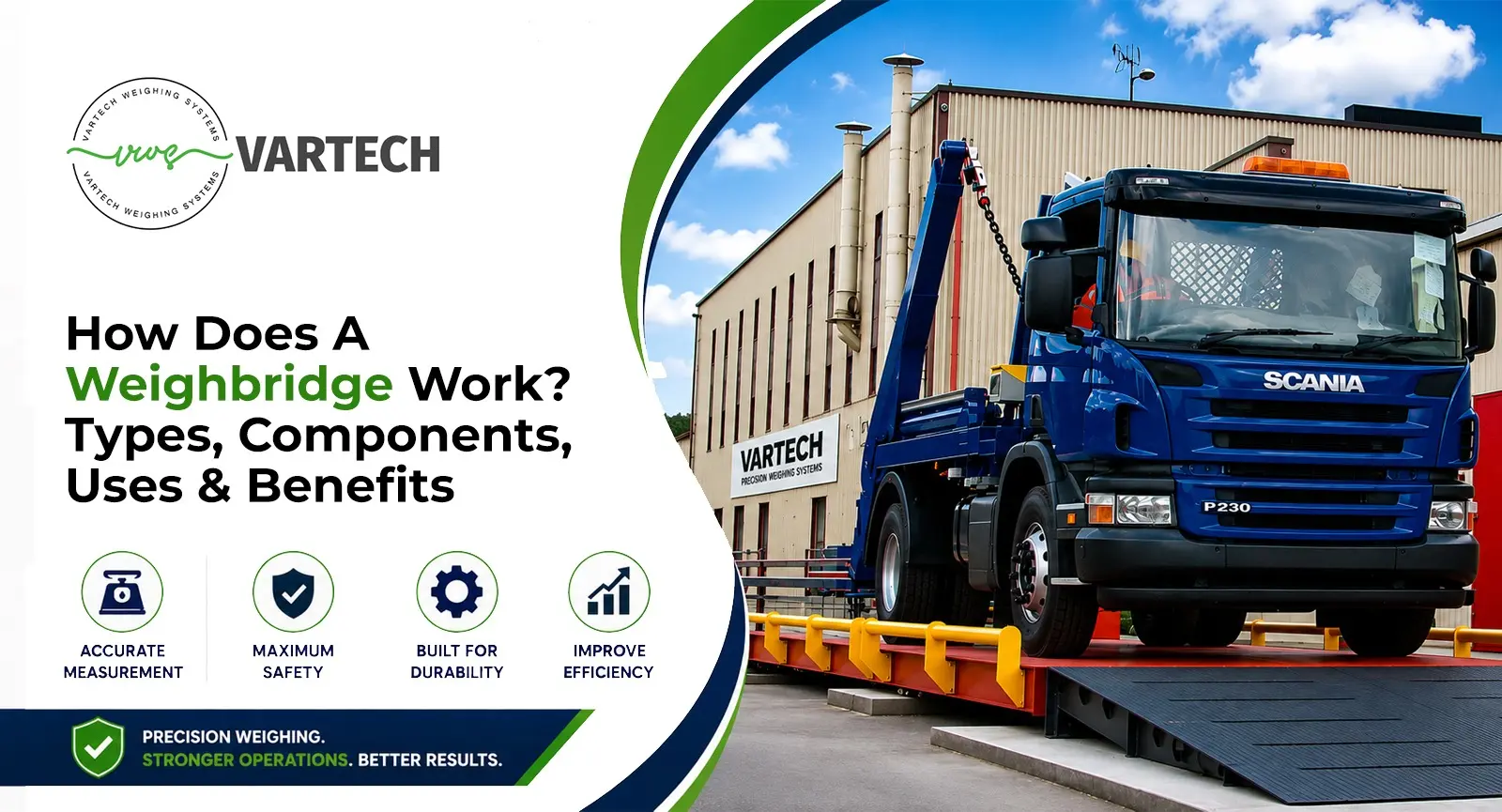
Quick Summary: A weighbridge weighs the whole vehicle, not just the cargo, and it does it in seconds using load cells buried under a platform. This article is all about how that happens, the different types you’ll run into, which parts matter for accuracy, where these things get used day to day, and why the cheap option often costs more later.
Table of Contents
Ever noticed how a loaded truck can roll onto a platform, remain there for a few seconds, and drive off with its exact weight already recorded, without the driver even getting out? That’s basically what a weighbridge does, and most of us just don’t pay attention to it until we actually need one. But step into any industry that deals with bulk goods- think transport companies, construction sites, mining operations, or even toll authorities- and you’ll realise the type of work these machines are doing. At first glance, this is nothing fancy, just a big flat platform built into the ground. But once you look at what’s happening underneath- the sensors, the load cells, the wiring, the software- you start to appreciate how much engineering goes into getting that one simple number right. So in this article, we’ll talk about how weighbridges work, the different types, the parts that make them tick, and why so many businesses rely on them daily.
Take away the steel and concrete, and this is just a big flat surface sitting on top of sensors that do all the work. Its functions are as follows:
All of this happens fast enough that a truck barely has to slow down, which is exactly why busy sites don’t grind to a halt every time a vehicle needs weighing.
Not every site needs the same kind of weighbridge, and the right pick usually comes down to space, traffic, and how permanent the setup needs to be. Different types of bridges are:
These are placed on the ground, built into a dug-out pit, so trucks just drive straight on without a ramp. Good option when space is tight, or a ramp would just be in the way.
These are placed above ground, so vehicles need a ramp to get up onto them. No digging required, which means faster, cheaper installation, and it’s a lot easier to get underneath later for maintenance.
Exactly what it sounds like. These are built to move, and are perfect for a temporary work site or a farm that only needs weighing capability for part of the year.
Here’s the thing most buyers get wrong: they judge a weighbridge by its size, even though the parts that actually determine whether it stays accurate are mostly hidden.
Load cell quality is the big one. Cheap cells drift out of calibration faster, especially once they’re taking a beating from heavy trucks day after day. Platform material matters too; steel tends to hold up better than concrete once traffic gets heavy. Then there’s the junction box and its cabling, which need to be sealed properly, because moisture creeping in there is one of the most common reasons readings start going wrong. And don’t ignore the software running the indicator. Clunky software that can’t export data properly turns a good weighbridge into a daily headache at high-volume sites.
If there’s one lesson here, it’s this: spend on the load cells first. The platform can be the shiniest thing on the lot and still give you garbage numbers if what’s underneath isn’t built well.
You’ll find these wherever a vehicle’s weight actually decides how much money changes hands, or whether something’s legal to move. These are used in the following places:
A weighbridge that’s specified well does more than spit out a number.
Billing disputes drop, since there’s no ambiguity left about how much material actually moved. Compliance gets easier, especially in industries where an overloaded truck is a legal problem waiting to happen. Trucks move through faster instead of backing up in a line, which matters a lot during a busy shift. And the weight data itself feeds into bigger systems, inventory, logistics, and reporting, so getting it right at the source saves headaches everywhere downstream.
A weighbridge rarely announces that something’s wrong. It just starts giving numbers that don’t quite match reality, and by the time anyone notices, the problem’s usually been there a while. A few things worth watching for:
None of these signs mean a weighbridge needs replacing right away. Most of the time, they mean it needs a proper inspection before a small issue turns into a bigger, more expensive one.
At the end of the day, it isn’t just a slab of steel on the ground; it’s a system that keeps businesses accurate, compliant, and running smoothly. From logistics to construction to mining, getting that weight right matters more than people realise. If you’re looking to invest in a reliable, well-built weighbridge, it’s worth going with a name you can trust. That’s exactly where Vartechweighing comes in, offering durable, accurate, and industry-ready weighing solutions built to handle the working demands, day in and day out.
It comes down to load cell quality and how well the system's calibrated, but a properly maintained one is accurate enough for billing and regulatory purposes without much margin for error.
Depends on how much traffic it sees and local rules, but once a year is common, with more frequent checks for busier sites.
Pit-type sits flush with the ground and needs digging. Pitless sits above ground and needs a ramp instead, usually quicker and cheaper to put in.
Pit-type and pitless ones are basically permanent. Portable weighbridges are the ones actually built for moving between locations.
Usually it's load cells drifting, moisture getting into the wiring, or nobody bothering with regular calibration. All three chip away at accuracy if left alone long enough.