

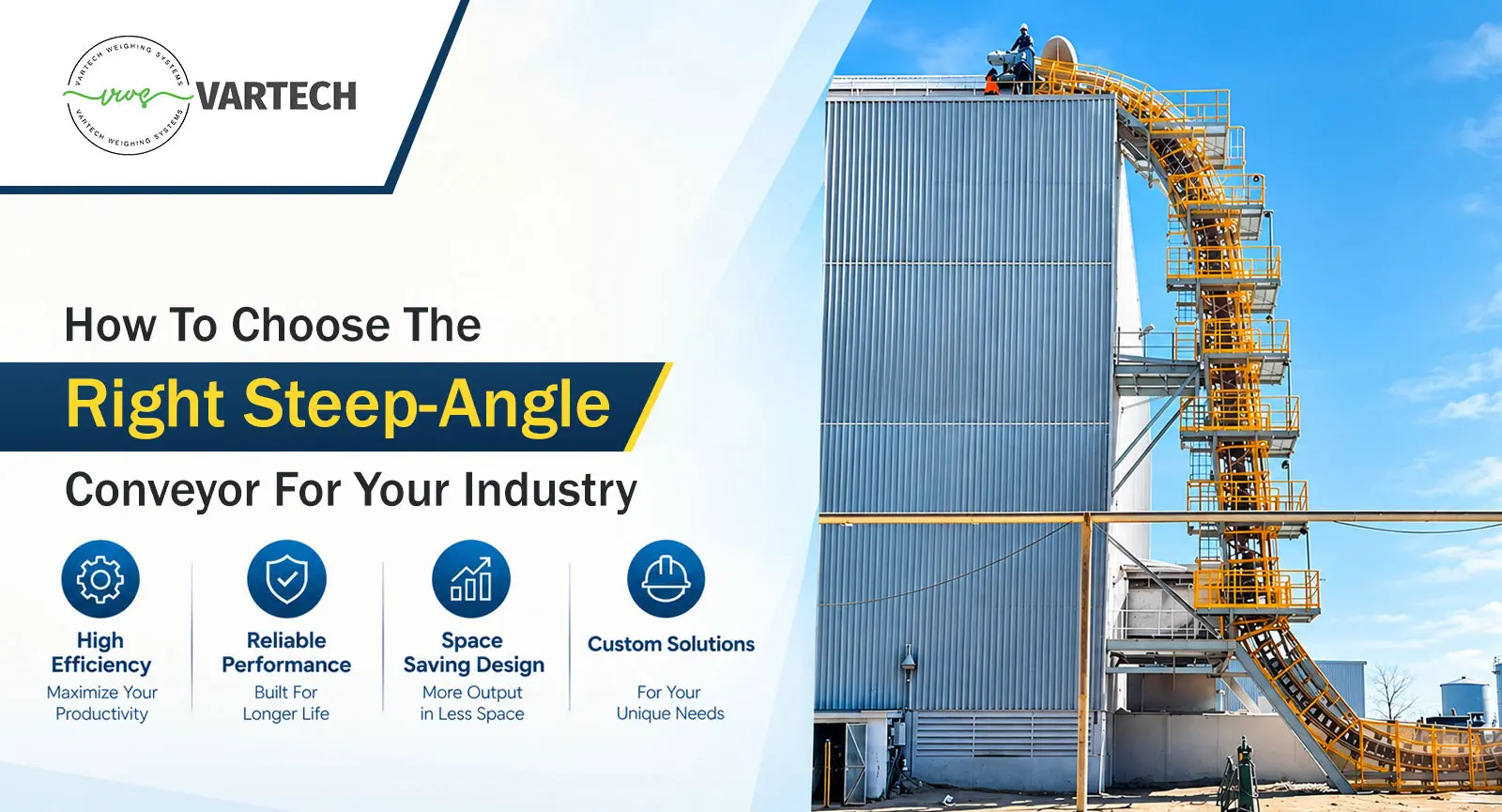
Quick Summary: A steep-angle conveyor moves bulk material at inclines well beyond what a standard belt conveyor can handle, from 18 degrees up to a full 90 degrees vertical. Picking the right conveyor depends on certain factors like incline angle, throughput, material type, belt design, and how much floor space you actually have to work with. This article discusses all those in detail, along with the mistakes that send buyers back to the drawing board after installation.
Table of Contents
Introduction
Most material handling problems come down to one thing: getting material up without losing half of it, without dust everywhere, and without a conveyor so long it takes over the plant. A standard troughed belt conveyor tops out around 15 to 18 degrees before material starts sliding back down. Beyond that, plants either stretch the conveyor out to reduce the effective angle, switch to a bucket elevator, or bring in a steep-angle conveyor built specifically to hold material in place at much steeper inclines. That last option has become the more practical choice across mining, cement, ports, power plants, and fertilizer handling, mainly because it does the work of an incline conveyor and a bucket elevator in one machine, without the extra transfer points either alternative usually needs. This article breaks down exactly what to check before choosing a steep angle conveyor for your specific application.What Makes a Conveyor Steep Angle?
A steep angle conveyor is built to carry bulk material at inclines beyond what standard cleated or chevron belting can manage, typically past 30 degrees and up to a full vertical lift. It does this through corrugated sidewall belting, which forms raised pockets along the belt to contain material physically, or through a sandwich belt design, where a second belt presses down on top of the material to hold it in place as it climbs. The practical benefit is fewer transfer points. A conventional setup moving material up and over often needs multiple conveyors and hoppers stacked together, each one a place where material can spill, degrade, or kick up dust. A steep-angle conveyor handles the same vertical lift in one continuous run, which is a big part of why it gets specified for dusty or fragile materials like coal fines, fertilizer, or grain.What to Look At Before Choosing a Steep-Angle Conveyor?
Getting the angle right but underestimating throughput, or nailing capacity but ignoring what the material does when it’s wet, both lead to the same outcome: a conveyor that underperforms the day it’s switched on. The following are the things one needs to look at before they decide to buy one:1. The Angle You Actually Need
This is usually the first place buyers get it wrong. The exact angle changes which belt technology is even viable: standard cleated belting handles up to roughly 30 degrees, corrugated sidewall belting extends that range up toward 90 degrees, and full sandwich belt designs are typically reserved for the steepest, highest-capacity applications. Specify a steep-angle conveyor for 45 degrees when your site layout needs 60, and you’re not looking at a small adjustment; you’re looking at a different belt system altogether.2. Throughput and Capacity
Capacity requirements for steep-angle conveyors in industrial and mining use range commonly from a couple hundred tonnes per hour up into the thousands, and this number drives everything downstream: belt width, drive power, and the specific containment design needed to keep that volume of material from spilling at a steep incline. Sizing a conveyor for today’s output without factoring in planned expansion is one of the more expensive mistakes to fix later, since upgrading capacity on an installed steep-angle conveyor usually means replacing major components rather than adjusting a setting.3. What the Material Is Actually Like
Bulk density, moisture content, particle size, and abrasiveness all affect how a material reacts once it’s on an incline. A dry, free-flowing material reacts very differently at 60 degrees than something damp and sticky that clings to the belt or sidewalls. Abrasive materials, ore or aggregate, wear down belting and components faster, which affects both the belt specification and how often maintenance needs to happen on the steep angle conveyor. Getting this wrong doesn’t usually show up on day one; it shows up as unexpected wear a few months into operation.4. Belt Design and Containment Method
Corrugated sidewall belts and sandwich belt systems solve the same core problem, keeping material from sliding back, but they suit different situations. Sidewall belting tends to be the more common, cost-effective choice for a wide range of bulk materials at steep but not fully vertical angles. Sandwich belt designs are generally reserved for very steep-angle conveyors or vertical lifts, higher capacities, or materials that need extra containment pressure to stay in place, which is also why they tend to cost more upfront.5. Footprint Versus a Bucket Elevator
Bucket elevators have long been the default for vertical material lifting, but they come with their own trade-offs, more moving parts, more maintenance points, and generally lower throughput ceilings compared to a well-specified steep angle conveyor. If floor space is tight and you need a continuous run rather than a boxed-in vertical structure, a conveyor is the best option on footprint and long-term maintenance simplicity, though the upfront cost comparison depends heavily on the specific capacity and angle involved.6. Industry-Specific Demands
Mining and cement applications typically prioritize handling abrasive, high-volume material reliably over long operating hours. Port and ship-loading operations care more about consistent throughput and minimizing dust during loading. Fertilizer and grain handling need gentler material handling to avoid degrading the product itself. The right steep-angle conveyor for one industry isn’t automatically right for another, even at the same angle and capacity, because the priority shifts from raw durability to product preservation.Common Mistakes Buyers Make While Choosing a Steep Angle Conveyor
Most of these mistakes don’t show up on installation day; they show up months later, once the conveyor’s already running and changing course gets expensive. These are some of the common mistakes that buyers make:- Sizing for today’s output, not tomorrow’s. A conveyor bought to match current throughput often hits its ceiling within a year or two, and by then, upgrading usually means swapping out major components, not adjusting a setting.
- Skipping a proper site survey. Assuming a standard configuration will just fit into an existing structure, without checking clearance, support points, or what civil work already exists, is how buyers end up with a conveyor that doesn’t actually fit the space it was bought for.
- Ignoring how the material changes with weather or handling. A material that flows fine when dry can react completely differently after a rainy season, or a change in how it’s stored, and a steep-angle conveyor spec that doesn’t account for that ends up underperforming exactly when it’s needed most.
- Choosing belt design based on price alone. Corrugated sidewall belting looks like the cheaper option upfront, but for very steep or high-capacity applications, it can wear out faster than a sandwich belt system built for that exact load, costing more in replacements down the line.
Conclusion
Choosing the right steep angle conveyor really comes down to matching belt profile, incline, and throughput to what you’re actually moving, not just grabbing whatever handles the steepest angle. Get that match right, and you skip the spillage, jams, and early wear that come with a poor fit. Vartech Weighing Systems builds every recommendation around your major operating conditions, so the conveyor you end up with actually moves material the way your operation needs it to, day after day.FAQs
Is a steep angle conveyor cheaper than a bucket elevator long-term?
It depends on capacity and site layout, but steep angle conveyors generally involve fewer moving parts and transfer points than a bucket elevator, which often translates to lower maintenance costs over the equipment's working life.
Can the same conveyor handle multiple material types?
It can, but the belt and containment design need to suit the most demanding material you'll run, not just the easiest one, since abrasiveness and moisture content both affect wear and containment needs differently.
How much does site layout affect the final conveyor design?
Significantly. Available height, existing structural supports, and loading and discharge point locations all shape the practical design, which is why a proper site survey usually happens before a final specification is confirmed.
Does a steep angle conveyor need more maintenance than a standard incline conveyor?
Not inherently more, but the maintenance focus shifts toward sidewall or sandwich belt condition and containment integrity, since those are the components under the most stress at steep inclines.
What's the maximum angle a steep angle conveyor can actually handle?
Depending on the belt design, steep angle conveyors can run anywhere from around 18 degrees up to a full 90 degrees vertical, with corrugated sidewall belting and sandwich belt systems each suited to different portions of that range.

Comments are closed